Doxing in Cybersecurity: How Visiting a Website Can Put Your Personal Information at Risk
In today’s digital world, personal information has become one of the most valuable assets for cybercriminals. Your name, email address, phone number, workplace, location, social media accounts, and other information can potentially be collected and misused by attackers.
One cybersecurity threat that takes advantage of exposed personal information is doxing.
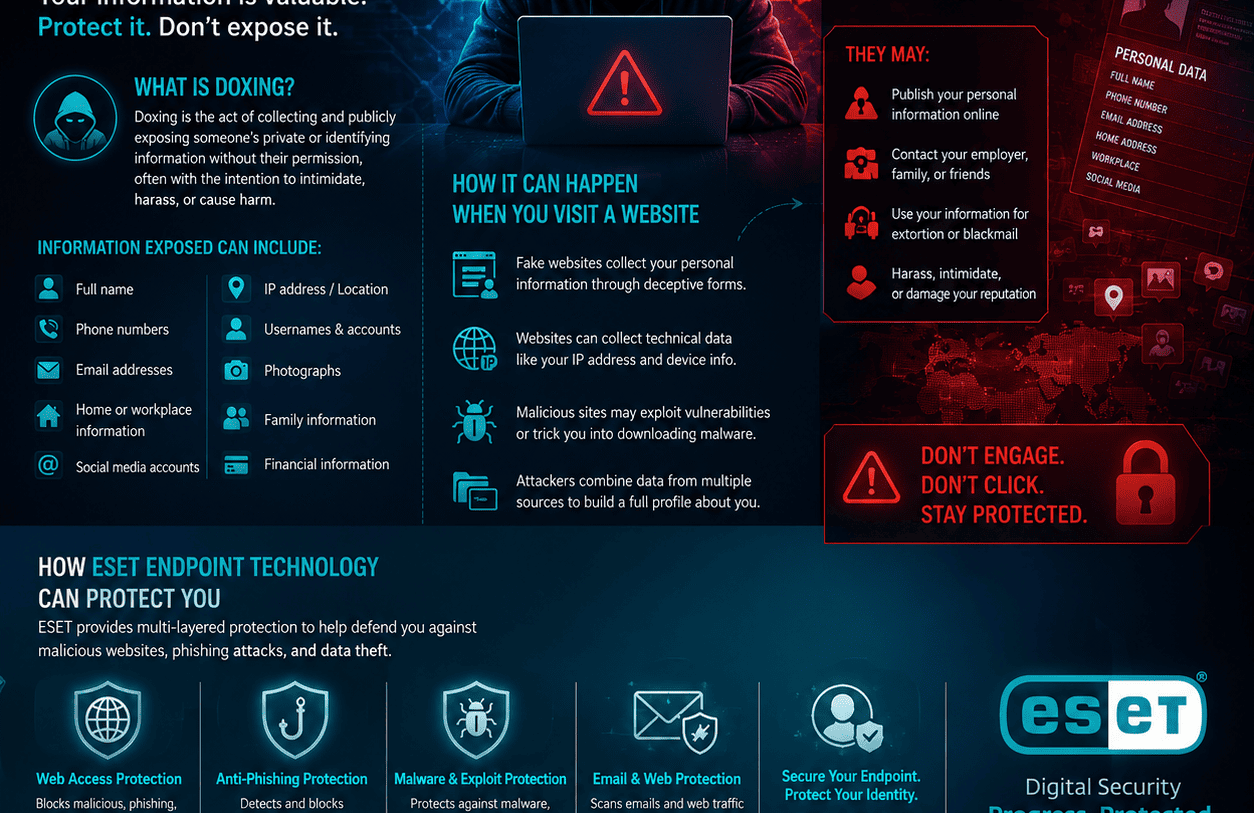
What Is Doxing?
Doxing (or doxxing) is the act of collecting and publicly exposing someone’s private or identifying information without their permission, often with the intention of intimidating, harassing, threatening, embarrassing, or causing harm to the victim.
The information exposed may include:
- Full name
- Phone numbers
- Email addresses
- Home or workplace information
- Social media accounts
- Photographs
- Family information
- IP address or approximate location
- Usernames and online accounts
- Financial or other sensitive information
Doxing does not necessarily begin with a sophisticated cyberattack. Sometimes, attackers build a profile of their target by combining information obtained from websites, social media, data breaches, phishing attacks, and publicly available sources.
How Can Visiting a Website Become a Security Risk?
Simply visiting a legitimate website does not automatically mean you will be doxed. However, malicious or compromised websites can be used as part of a broader attack.
For example, an attacker may create a fake website that looks like a legitimate banking service, Microsoft 365 login page, social network, or business portal. The victim receives a link through email, SMS, social media, or another communication channel.
When the victim visits the website, the attacker may attempt to:
- Trick the user into entering personal information
A fake login page may request usernames, passwords, phone numbers, or other information. - Collect technical information
Websites can normally receive certain connection information such as an IP address and browser/device characteristics. This information alone generally does not reveal someone’s exact home address, but it can contribute to an attacker’s profile. - Deliver malicious content
A compromised or malicious website may attempt to exploit browser or software vulnerabilities or persuade the visitor to download a malicious file. - Redirect the victim to another malicious website
Attackers can use multiple redirects to move users toward phishing or malware-hosting pages. - Combine information from different sources
An attacker may combine information obtained online with social media information, leaked databases, and previously compromised accounts.
This is why web security is an important part of endpoint security.
How Attackers Use Doxing to Threaten Victims
Doxing can become particularly dangerous when attackers use the information they have collected to pressure or intimidate a victim.
An attacker might send a message such as:
“We know who you are, where you work, and how to contact you. If you don’t do what we ask, we will publish your information.”
This can be used as part of digital extortion, harassment, intimidation, or social engineering.
The attacker may threaten to publish information publicly, contact the victim’s employer or family, expose private photographs, or release information through social media.
The goal is often to create fear and urgency, causing the victim to make a decision they would not normally make.
What Should You Do If Someone Threatens You?
Do not respond emotionally or provide additional information.
Instead:
- Preserve screenshots and relevant messages.
- Do not click additional links sent by the attacker.
- Do not provide passwords, verification codes, or financial information.
- Change compromised passwords from a trusted device.
- Enable multi-factor authentication.
- Report abusive accounts or content to the relevant platform.
- Contact your organization’s IT/security team if a business account or device is involved.
- If there is a credible threat of physical harm, contact appropriate local authorities.
How ESET Endpoint Technology Can Help
Endpoint protection cannot prevent every form of doxing because doxing is fundamentally about the collection and publication of personal information. However, strong endpoint security can help prevent some of the attacks that criminals may use to obtain that information in the first place.
ESET Endpoint Security provides security capabilities that can help protect users while they browse the internet and use email and applications.
1. Web Access Protection
ESET Endpoint Security includes Web Access Protection, which scans HTTP/HTTPS communications for malware and phishing threats. ESET recommends keeping Web Access Protection enabled.
This can provide an important layer of protection when employees click links or browse potentially dangerous websites.
2. Anti-Phishing Protection
Phishing is one of the common ways attackers attempt to obtain credentials and sensitive information.
ESET’s Anti-Phishing Protection is designed to block known phishing websites. When a recognized phishing site is accessed, ESET can terminate the connection and display a warning to the user.
This is particularly important because a successful phishing attack could give criminals access to email, cloud storage, social media, or corporate accounts containing valuable personal information.
3. Protection Against Malicious Websites
Attackers may use websites to deliver malicious content rather than simply steal information through a fake form. ESET’s web protection can help detect and block malicious web activity before it becomes a larger endpoint security incident.
4. Email and Web Protection Working Together
Doxing-related attacks can start with an email containing a malicious link. Endpoint protection that covers both email and web traffic can provide multiple defensive layers.
ESET Endpoint Security includes email client protection and web/email security capabilities designed to help identify malicious communications and threats.
Doxing Is Also a Data-Privacy Problem
Technology alone is not enough.
Organizations should combine endpoint protection with:
Endpoint Security + Secure Browsing + MFA + Strong Passwords + Security Awareness + Data Protection
Employees should understand that information posted publicly can sometimes be combined with information from other sources to create a much more detailed profile.
Businesses should also limit unnecessary exposure of employee information, protect customer databases, control access to sensitive systems, and monitor for suspicious activity.
Final Thoughts
Doxing demonstrates how personal information can become a cybersecurity weapon.
An attacker may start with something as simple as a malicious link, fake website, phishing message, or information already available online. From there, they can attempt to obtain credentials, compromise accounts, collect additional information, and ultimately use that information to intimidate or threaten the victim.
For businesses, protecting employees and customers therefore requires more than traditional antivirus. Web protection, anti-phishing capabilities, endpoint security, identity protection, employee awareness, and strong access controls must work together.
Solutions such as ESET Endpoint Security can form an important defensive layer by helping block malicious and phishing websites and protecting endpoints during everyday web and email activity.
Your personal information is valuable. Protect the endpoint that connects you to the internet.